
October/15/2017
Beer selection can ensure long-term survival
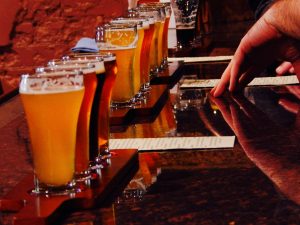 No one — not even Sam Malone, Moe Szyslak, or Lloyd from the Overlook Hotel — got into tending bar without hoping to have a successful business. Well, maybe Lloyd didn’t.
The heart of every bar operation is the beer. With the proper fine tuning, your beer selection can ensure the long-term survival of your precious watering hole. The key is finding the right balance between what’s expected and the overwhelming.
Having a broad and deep selection of brews works for some bars, as that’s what they’ve built their reputation on (think International House of Beers where there’s more than 400 different beers on tap). Customers come in expecting a beer menu that’s as long as War and Peace. They enjoy the fact that they can stop by and try a different beer every day for an entire year and still be barely halfway through the beer catalog. Variety is the spice of life, as they say.
But for smaller operations, less is more.
One of the most common mistakes bars can make is trying to be everything to everyone. While it’s nice to say you have 20 different IPAs or 30 different shandys available, what good is that to your bottom line when the majority of them are rarely, if ever, served? Those virtually untouched beers are taking away precious real estate in your keg system or refrigerators from beers that sell.
Still, not every customer is going to come in and order the same beer every time — sometimes even your regulars want to be adventurous. That’s where seasonal beers or limited-run brews can make the difference in keeping your devoted customers coming back and developing friendships with new customers. Simply put, a small, regularly changing variety of beer can be your pub’s best friend.
~~~~~~~~~~~~~~~~~~~~~~~~~~~~~~~~~~~~~~~~~~~~~~~~~~~~~~
September/10/2017
Yes we can!
It’s a decades-long debate — cans vs. bottles — that appears to be resurfacing as the craft beer boom continues and breweries decide how they’ll package their product.
Here’s a quick look at what those in both camps are saying: 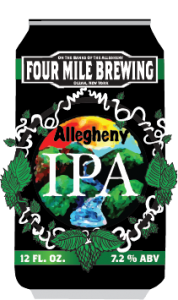
Many brewers and beer aficionados argue canned beer is best, maintaining innovations in beer cans help preserve flavor and quality of any brew. Cans do not let harmful light permeate through to the precious contents inside, protecting the delicate organic parts of a beer that could easily skunk and produce off flavors. There’s also the durability beer cans boast that glass bottles just can’t compete with. Surveys of many breweries and trusted beer reviewers often have results favoring canned beer.
Allegheny IPA (can mock-up)
But why mess with tradition? Bottling beer is one of the oldest ways in which brews are stored. Bottle advocates note that most beer bottles are amber and filter our harmful light wavelengths that can spoil a perfectly good beer. What’s more, bottled beer stays colder longer once opened. Those on the bottle side with more refined palates point out canned beer can impart a metallic taste on a brew. For certain beers that require longer conditioning periods, cans just don’t stack up the same way bottles do, nor can they take the same amount of CO2 that a bottle can for preservation.
For us, as long as the beer is enjoyed properly with friends, we say “bottoms up.”
~~~~~~~~~~~~~~~~~~~~~~~~~~~~~~~~~~~~~~~~~~~~~~~~~~~~~~
August/13/2017
Experience NY Craft Beer
For us, there’s nothing better than kicking back after a hard day’s work during the summer with a cold craft beer. The same can be said for an evening with friends around a campfire. The right seasonal summer beer can make any memory of a harsh winter melt away.
To that end, here’s a few craft brews we think you should enjoy this summer:
1. On a hot summer day, it’s hard to go wrong with an IPA. Though an acquired taste for some, an IPA hits the palate with a strong hop aroma, strong hop flavor and strong hop finish. These beers are the ones that get your mind off of yard work and into a hammock. Sam Adams has a solid four-beer sampler of its Rebel IPA line. We also recommend Dogfish Head’s 90 Minute IPA and Great Lakes Steady Rollin’ Session IPA.
2. Our closest neighbors in Western New York produce a beer that’s become a regional favorite. And it’s just perfect to enjoy in warm weather. Ellicottville Brewing Co.’s Blueberry Wheat Ale is one of the brewery’s first beers and had remained a mainstay of its catalog of craft beers. Boasting a 4.8 ABV and 11 IBU, this golden ale dials in the right balance of Canadian barley, noble German hops, and blueberries for a brew that’s nothing short of refreshing.
3. Speaking of regional favorites, our friends a Resurgence Brewing Co. in Buffalo put a Western New York spin on a classic beer style. Combining the hybrid loganberry, whose parents are a raspberry and a blackberry, with Belgian witbier, Resurgence Brewing Co. came up with its Loganberry Wit. The uniquely-regional craft beer has a 4.2 % ABV and loganberry finish that takes many back to the Crystal Beach Amusement Park, a long-closed theme park just across the Canadian border from Buffalo where loganberry drinks were made popular.
4. One of our personal favorites from our repertoire is our Mango Wheat, 5.4 % ABV, 20 IBU. Brewed with 97 pounds of mango puree that’s added during fermentation, this pale wheat beer packs a refreshing tropical punch that’s sure to take the edge of of any day about 80 degrees. As one of our flagship beers, Mango Wheat has become a fan favorite and we can’t recommend it enough.
5. A few years ago, the craft beer industry saw a boom of sorts with a beer style that has European roots — the shandy. Within a matter of weeks, practically every macro and micro brewery began producing their own take the shandy, mixing beer with lemonade, grapefruit juice, watermelon, and even cranberries for a unique zing of flavor. Some of our go-to shandys include Leinenkugel, Curious Traveler, and ginger lemon Radler. While these beers’ ABV are generally lower, they’re perfect for summer sessioning.